

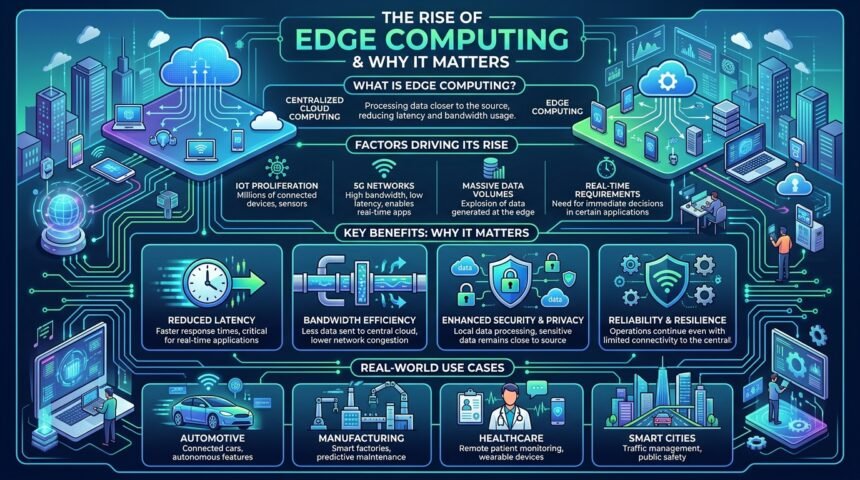
Edge computing has emerged as one of the most important technology trends as businesses generate and process larger amounts of data than ever before. Instead of sending all information to distant cloud servers, edge computing processes data closer to where it is created. This approach reduces delays, improves performance, and supports real-time applications. As industries adopt smart devices, Artificial Intelligence, and the Internet of Things, edge computing is becoming a key part of modern digital infrastructure.
What Is Edge Computing
Edge computing is a technology that processes data near the source where it is generated rather than relying entirely on centralized cloud servers. This allows devices to respond more quickly and reduces the amount of data that must travel across the internet.
By handling information locally, businesses can improve speed, efficiency, and reliability for critical applications.
Benefits Of Edge Computing
One of the biggest advantages of edge computing is lower latency. Faster data processing is essential for applications such as autonomous vehicles, industrial automation, healthcare monitoring, and smart cities.
Edge computing also reduces bandwidth usage by processing only necessary information before sending selected data to cloud platforms.
Edge Computing And The Internet Of Things
The rapid growth of Internet of Things devices has increased the demand for edge computing. Smart sensors, security cameras, wearable devices, and industrial equipment continuously generate large amounts of data.
Processing this information locally enables faster decision-making and improves the overall performance of connected systems.
Security And Privacy Advantages
Edge computing can improve security by reducing the amount of sensitive information transmitted across public networks. Processing data closer to its source helps organizations maintain better control over confidential information.
Businesses can also reduce the risk of network disruptions affecting mission-critical operations by relying on local processing capabilities.
Industries Adopting Edge Computing
Healthcare organizations use edge computing to monitor patients in real time, while manufacturers apply it for predictive maintenance and automated production systems. Retail businesses improve customer experiences through smart inventory management, and transportation companies use edge computing to optimize logistics and traffic management.
These industries benefit from faster response times and improved operational efficiency.
The Future Of Edge Computing
As 5G networks continue expanding, edge computing is expected to become even more powerful. Future developments will support advanced Artificial Intelligence, autonomous systems, robotics, and next-generation smart devices.
Organizations that adopt edge computing early will be better prepared to manage growing data demands while delivering faster and more reliable digital services.
FAQs
What Is Edge Computing
Edge computing is a technology that processes data closer to where it is generated instead of relying entirely on centralized cloud servers.
Why Is Edge Computing Important
It reduces latency, improves performance, lowers bandwidth usage, and supports real-time applications.
How Does Edge Computing Support IoT
It allows Internet of Things devices to process data locally, enabling faster responses and more efficient operations.
Which Industries Use Edge Computing
Healthcare, manufacturing, transportation, retail, telecommunications, and smart city projects widely use edge computing.
What Is The Future Of Edge Computing
Edge computing will continue growing alongside 5G, Artificial Intelligence, smart devices, and the Internet of Things to deliver faster and more intelligent digital services.
Conclusion
Edge computing is transforming the way businesses process and manage data by bringing computing power closer to users and connected devices. Its ability to improve speed, reliability, security, and efficiency makes it one of the most significant technology trends today. As digital transformation continues, edge computing will remain a vital technology for supporting the future of intelligent applications and connected systems.